

Our first ever week entirely devoted to explanation, discussion, and commitment to action on the subject of the environment is happening now. Soha Environment Awareness Week 2021 will take over the bulk of our social media posts during the week 15 – 19 November with the hashtag #SohaEAW2021. We hope to run a similar campaign every year.
The sources and inspiration for the topics have come from The Soha Green Team made up of staff and residents. Most of the social media posts are containable within a Facebook post (linked to from Twitter) but some are more lengthy and will be posted here with the most recent uppermost.
We hope you will find something during the week that ignites your interest and encourages you that we are serious about lessening our impact on the environment and, importantly, giving our residents the tools to do likewise.
We grow together.
Tuesday 16 November
Continuing the look at our properties which has been the focus for today, here’s a piece by Lee Hayward, Director of Property Services, on where we are now – and where we hope to be #SohaEAW2021
Soha has developed approximately 35% of its stock since 2000. This means that Soha has a significant proportion of newer stock and these properties have been constructed to higher energy efficiency standards required by modern building regulations. It should also be noted that 37% of Soha’s properties are already over 50 years old and the remaining 28% of properties will be over 50 years old by 2050. All Soha’s properties are heated and have double glazed windows and insulated lofts and cavity walls, where possible.
In January 2020 Soha agreed to replace 681 properties that currently have sub-standard Electric Storage Heaters with either gas heating or Air Source Heat Pumps. These are among the least energy efficient properties that Soha owns and this replacement programme will do a great deal to reduce carbon emissions and reduce residents’ running costs. In 2020/21 we replaced the electric storage heater systems in 30 properties with air source heating systems and we are in the process of installing a further 120 air source heating systems in 2021/22. Soha received 70% grant funding for this work via the government’s Renewable Heat Incentive however this grant stream is currently due to expire in March 2022.
Soha has recently purchased an energy performance modelling solution called Intelligent Energy from Sava. Intelligent Energy provides insight and improvement planning for zero carbon. It uses data directly from our asset management system Aareon QL and calculates energy results (including improvement measures) with minimal data ensuring Soha has a picture of our whole housing stock, how its performing in terms of current SAP and EPC ratings. It also has the ability to produce investment plans that will identify what work we need to carry out in our properties to achieve the government’s energy improvement targets. This software will provide us with our baseline position in respect of our property’s current carbon emissions and SAP ratings together with a detailed insight into the nature of work required, how much it will cost and how long it’s likely to take to complete.
Soha has also committed to purchase Holmes Asset Strategic Software from 221 Group. The Holmes software uses data from Soha’s main housing management system Aareon QL such as management costs, repair and void costs, rental return, void loss, property age, condition etc. to return a Net Present Value for each property over a 30 year period. Holmes can quickly identify poorly performing assets and its Cloud based technology ensures everyone has the tools to hand to review and identify assets requiring an options appraisal. Its proprietary financial forecasting model will enable Soha’s Senior Leadership Team and Board to assess the long-term performance of its entire portfolio over a 30 year period which will assist us in making the right choices around asset retention, investment, regeneration and disposal.
Soha Homes – our targets
Soha’s ambition is to reduce carbon emissions to net zero by 2050 and improve the energy efficiency of its properties to a minimum of EPC band C by 2030 thereby ensuring all residents have a home that is comfortable, healthy and affordable to run. Figures produced by Bioregional Consultants estimate the percentage carbon footprint of Soha, both of its property portfolio and its business activity divide up as on the pie charts below.
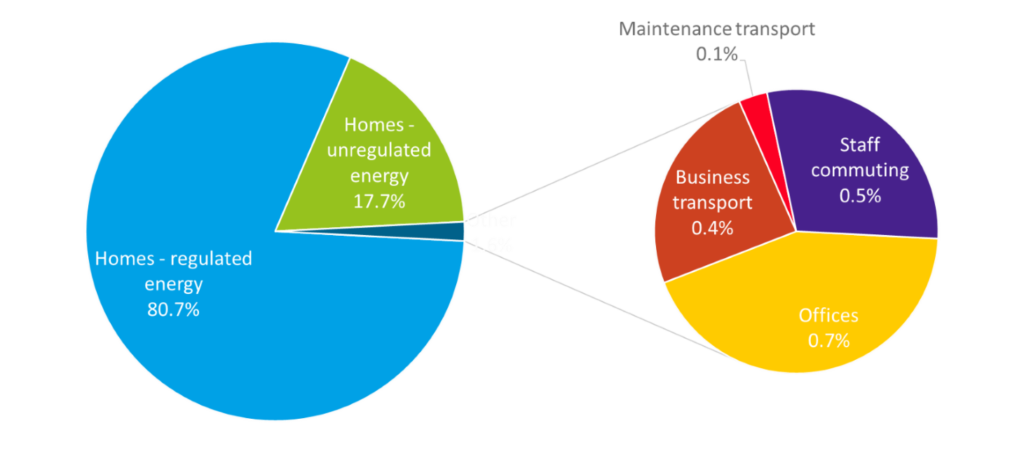
These show that 80.7% of Soha’s carbon footprint comes from our homes’ regulated energy (heating, hot water, lighting etc.); 17.7% of Soha’s carbon footprint comes from our homes’ unregulated energy (electrical appliances, cooking, IT equipment etc.) with only 1.6% of Soha’s carbon footprint coming from business activities (please see below).
It is reducing the carbon footprint of our properties that by far offers the greatest opportunity and will require the greatest investment to make a positive environmental difference. This is therefore the most detailed area of this strategy.
Soha Homes – our actions
Soha must also carefully consider how it will fund the work required to bring its property portfolio up to Net Zero Carbon by 2050. Our calculations (see section below) have resulted in us estimating it will cost on average around £24k per property to upgrade Soha’s existing homes to net carbon zero. This is a total investment required of £148 million excluding grant. The Government has already announced a £3.8 billion Social Housing Decarbonisation Fund (SHDF). The first wave of SHDF funding was released in August 2021 for properties rated EPC Band D or below. The fund aims to improve the energy efficiency of properties to a minimum of EPC band C on a ‘worst first’ basis adopting a ‘fabric first’ approach.
A ‘fabric first’ approach to building design involves maximising the performance of the components and materials that make up the building fabric itself, before considering the use of mechanical or electrical building services systems. This can help reduce capital and operational costs, improve energy efficiency, and reduce carbon emissions.
The SHDF wave one fund will meet 66.67% of all eligible costs however the maximum contribution is capped on a sliding scale based on a property’s existing EPC rating, with the poorest performing properties being eligible for more grant. Soha aims to bid for the second wave of SHDF funding which is due to be released in Spring 2022. It’s vital for Soha to have schemes ‘oven ready’ as quickly as possible so this funding and any similar grant programmes can be accessed in future.
Soha is developing schemes carried out on its own land to an energy efficient standard that exceeds building regulations by 20%. However, the vast majority of our new build properties are still acquired via Section 106 Agreements and these homes are not currently being built to operate at Net Zero Carbon. Therefore these homes will require retrofitting ahead of the Government’s 2050 deadline at an estimated cost of around £20k per property.
Soha’s Environmental ambitions need to be dovetailed with the need to run an efficient and sustainable business that continues to provide new and existing residents with affordable homes. We will therefore aim to utilise technologies that are tried and tested and that we are confident will be reliable and affordable as well as environmentally sound. The decisions on the sequencing of our work (see indicative programme below) is designed to enable us to benefit from future technological advances and a maturing market before making very major investments in, for example, replacing heating systems.
During the first year of the strategy Soha will use data extracted from Intelligent Energy and Holmes to prioritise energy improvement work focusing on the poorest performing properties first and to help make informed decisions about the future of our stock investment. A detailed programme of work will be produced including costings to model the work we need to carry out year on year to achieve our targets of all homes being a minimum of EPC band C by 2030 and Net Zero Carbon by 2050. Future annual budgets will be adjusted as required to fund this work.
It’s anticipated at this stage there will be a modest asset disposal programme having considered the best financial and social impact for each property within our broader vision to build sustainable communities. Our financial modelling shows that we can afford to invest to bring our homes up to net zero carbon without needing income from property disposals. We are therefore able to commit that where a property is sold we will replace each sold home for at least one new Soha property.
Any decision to sell existing homes will be approved by Soha’s senior leadership team and ratified by Board and will be based on sound judgement including but not limited to a property’s desirability, estimated future management costs, predicted future maintenance costs to achieve Net Zero Carbon, Net Present Value, demand and tenant feedback and need for affordable housing in that community. Re-generation and retrofitting options will also be considered ahead of recommending the sale of a property or properties.